


Hey Arcaders!
Now we have come to the big one.
every company has their killer app…
Namco had Pac-Man.
Nintendo had Donkey Kong.
Universal had Mr.Do!
Mr. Do! is one of the most iconic arcade games of the early 1980s, created by the Japanese company Universal Co., Ltd. Released in 1982, the game blended maze-navigation, puzzle mechanics, and action elements in a unique and charming way. Its success led to a full franchise spanning multiple sequels, ports, and later remakes. Let’s go over the full history of Mr. Do!, including its development, sequels, ports, and long-term legacy.
In 1982, Universal released Mr. Do!, an arcade maze game designed by Kazutoshi Ueda. Inspired by Namco’s Dig Dug, the game involved navigating tunnels, collecting cherries, and avoiding enemies called “Creeps.” However, Mr. Do! innovated beyond its competition by adding features like:
A bouncing Power Ball that Mr. Do could throw to defeat enemies.
Giant apples that could be dropped on enemies.
Multiple ways to clear a level, including defeating all enemies, collecting all cherries, or spelling “EXTRA.”
Like all Universal’s games- it was inspired by another game… Namco’s Dig Dug. Fun fact- One of the standout design ideas: Mr. Do’s “power ball” (used to defeat monsters) came from Ueda observing a Super Ball caught on a roof near Universal’s office. And unlike many arcade games of the time, Mr. Do! was released both as a standalone arcade cabinet and as a conversion kit, significantly increasing its success among arcade operators. For most operators of the time this was their first CONVERSION KIT. If you want to read a great interview with Ueda… head over to Source Gaming! they go over the games inception and the superball story. It’s a great read!
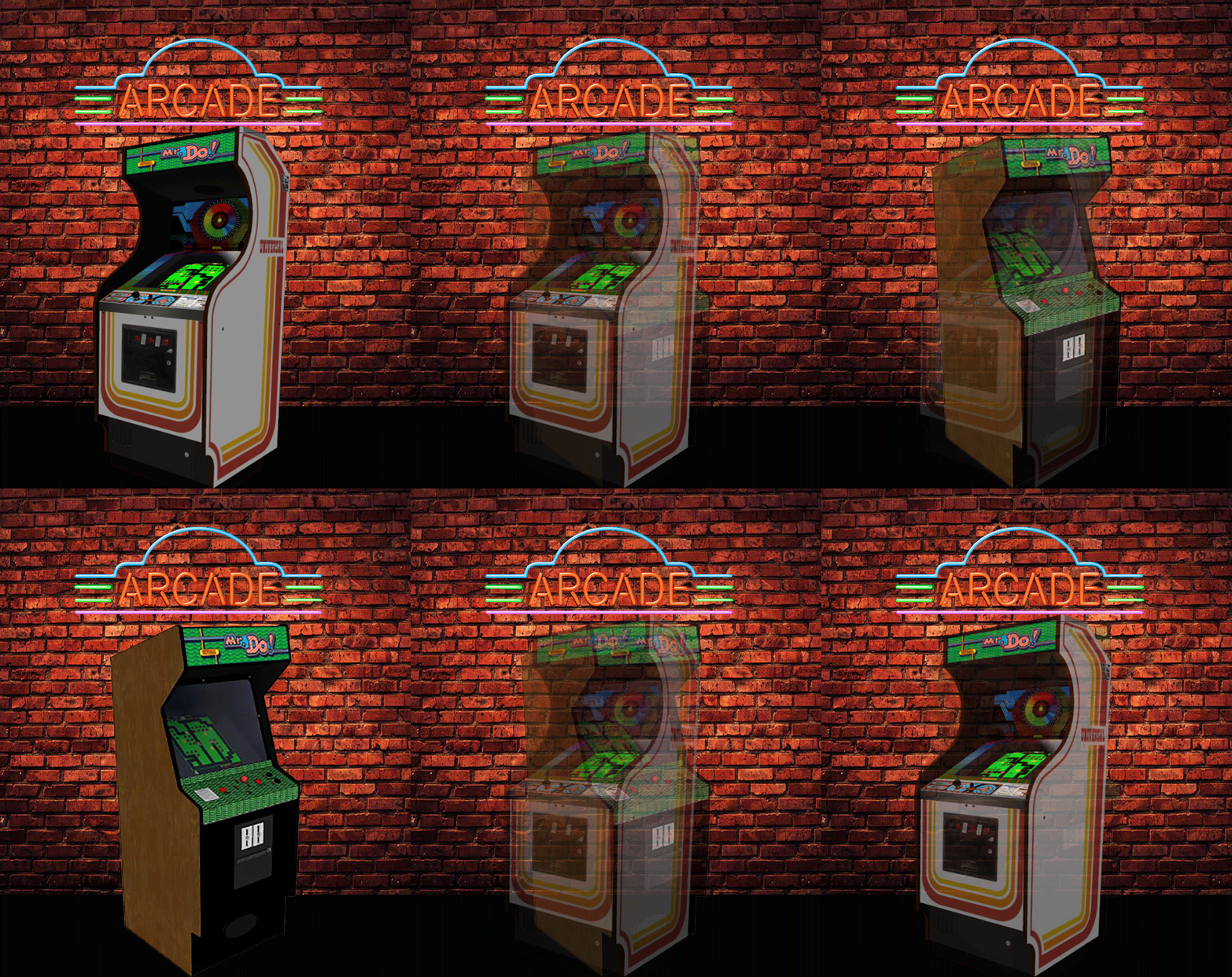
The first time I saw Mr. Do! It was at the Dream Machine in 1982… it was a conversion kit. It was around the time I started training as a technician.. I remember opening the cabinet (it started it’s life as a Frogger) and that’s where my passion for conversion kits started… being able to revive a cabinet not making money… or costly board set damage issues. And the game was insanely popular at my location… with IBM employees! Because of it’s steep challenge curve, and the way you can get extra lives- and free games- Introduced in earlier games like Ladybug and Snapjack- implemented by Ueda.. he loved pinball machines… the way you could win extra lives or free games. just watching suits… five or six deep… guys you knew never went to an arcade in their life… beating each other scores.. I’ve haven’t seen anything like it before or since!
And playing this classic was easy! almost every system had a version! Atari 2600, ColecoVision, Apple II, Atari 8-bit, Commodore 64, MSX, Tomy Tutor, even an excellent ports on the Gameboy and SNES over 10 years after it’s release!
Check them out!
The game was so popular- it had its own Japanese skill slot machine!
I like the game so much- when I got my Cricut- and my laser cutter… I made what I like to call- Joystickers! I’ve really got to start an Etsy account!

So- what do you think of Mr. Do! ? While I love Dig Dug…. Mr. Do! takes it to a whole other level! with the bright colors, changing playfields, varying.. changing monsters, the extra lives and – I keep coming back for more over 40 years later!
Next we’ll start talking about Mr. Do! s sequels- and each one couldn’t be more different! This when Universal came into their own… and unfortunately… were a few years from their own video game crash.
Keep playin’ like it’s 1981!
 The Arcade Archives!
I love this series so far. It is so very informative. I’ve never played Mr. Do for very long but it has always been an interesting game.
LikeLiked by 2 people
My first introduction to this game was when me and my sister visited Disney Quest so many years ago. Up to that point I had already visited the Blue Box one year before that so I invited my sister to come along, and surprisingly enough it was the arcade game that grabbed her attention, because she isn’t an Arcader at all, unless you can’t Mario Party for the Wii.
Having then played Mr. Do – especially after I joined the Blue Box – I can see that it is everything you said it was and more. It takes it’s cues from Dig Dug as well as other classics like Pac-Man to some extents.
Looking at the comparisons, I’m impressed the 2600 version looked as good it as it did. Though the Atari 8-Bit family and Commodore 64 versions look better than the Colecovision version. The Super NES was a spot-on copy of the original, and the NEO-GEO made the game even more brighter while keeping the gameplay intact.
In all, great job with this article Ray! It was a great way to bring new light on the history of the industry during that time, especially with a company that isn’t well-known yet at the same token left an indelible mark. 👍
LikeLiked by 2 people
Excuse me, “count Mario Party…”
LikeLiked by 2 people