


Hey Arcaders!
this one is special… it’s really what started the industry we know today… both in the arcade and home. There have been more conversions, ports, and adaptations of this game than any other… I give you…

Just keeping the game simple and fun to play is the secret. I had no idea that it would have such an impact.
The significance of Pong cant be stressed enough… Pong revitalized a industry- and turned it into what it is today.
was it an original game- by all accounts- no.
Ralph Baer laid the groundwork for Pong in 1958 when he proposed making simple video games that people could play on their home television sets. The Magnavox Odyssey, known as the first console video game system, was released in 1972 and offered a game of table tennis, or Ping-Pong.
Nolan needed a hit game after the unknown failure of Computer Space… It was Al Alcorn who provided it…

From Nolan wanted a driving a driving game- to compete with Chicago coin’s EM game Speedway. but decided to challenge him to create his own game.
To acclimate Alcorn to creating games, Bushnell gave him a project secretly meant to be a warm-up exercise. Bushnell told Alcorn that he had a contract with General Electric for a product, and asked Alcorn to create a simple game with one moving spot, two paddles, and digits for score keeping. In 2011, Bushnell stated that the game was inspired by previous versions of electronic tennis he had played before; Bushnell played a version on a PDP-1 computer in 1964 while attending college. However, Alcorn has claimed it was in direct response to Bushnell’s viewing of the Magnavox Odyssey’s Tennis game. In May 1972, Bushnell had visited the Magnavox Profit Caravan in Burlingame, California where he played the Magnavox Odyssey demonstration, specifically the table tennis game. Though he thought the game lacked quality, seeing it prompted Bushnell to assign the project to Alcorn.
Alcorn first examined Bushnell’s schematics for Computer Space, but found them to be illegible. He went on to create his own designs based on his knowledge of transistor–transistor logic (TTL) and Bushnell’s game. Feeling the basic game was too boring, Alcorn added features to give the game more appeal. He divided the paddle into eight segments to change the ball’s angle of return. For example, the center segments return the ball at a 90° angle in relation to the paddle, while the outer segments return the ball at smaller angles. He also made the ball accelerate the longer it remained in play; missing the ball reset the speed. Another feature was that the in-game paddles were unable to reach the top of the screen. This was caused by a simple circuit that had an inherent defect. Instead of dedicating time to fixing the defect, Alcorn decided it gave the game more difficulty and helped limit the time the game could be played; he imagined two skilled players being able to play forever otherwise. With the balls physics handed in software- unlike Baer’s- his was in the control… Alcorn simplified them by making the single plane movement potentiometers for more accurate movement. And thus.. Pong was born.

Now- if were talking about Pong… we have to talk about the “incident”. In August 1972, Bushnell and Alcorn installed the Pong prototype at a local bar, Andy Capp’s Tavern. They selected the bar because of their good working relation with the bar’s owner and manager, Bill Gaddis; Atari supplied pinball machines to Gaddis. Bushnell and Alcorn placed the prototype on one of the tables near the other entertainment machines: a jukebox, pinball machines, and Computer Space. The game was well received the first night and its popularity continued to grow over the next one and a half weeks. Bushnell then went on a business trip to Chicago to demonstrate Pong to executives at Bally and Midway Manufacturing; he intended to use Pong to fulfill his contract with Bally, rather than the driving game. A few days later, the prototype began exhibiting technical issues and Gaddis contacted Alcorn to fix it. Upon inspecting the machine, Alcorn discovered that the problem was that the coin mechanism was overflowing with quarters.
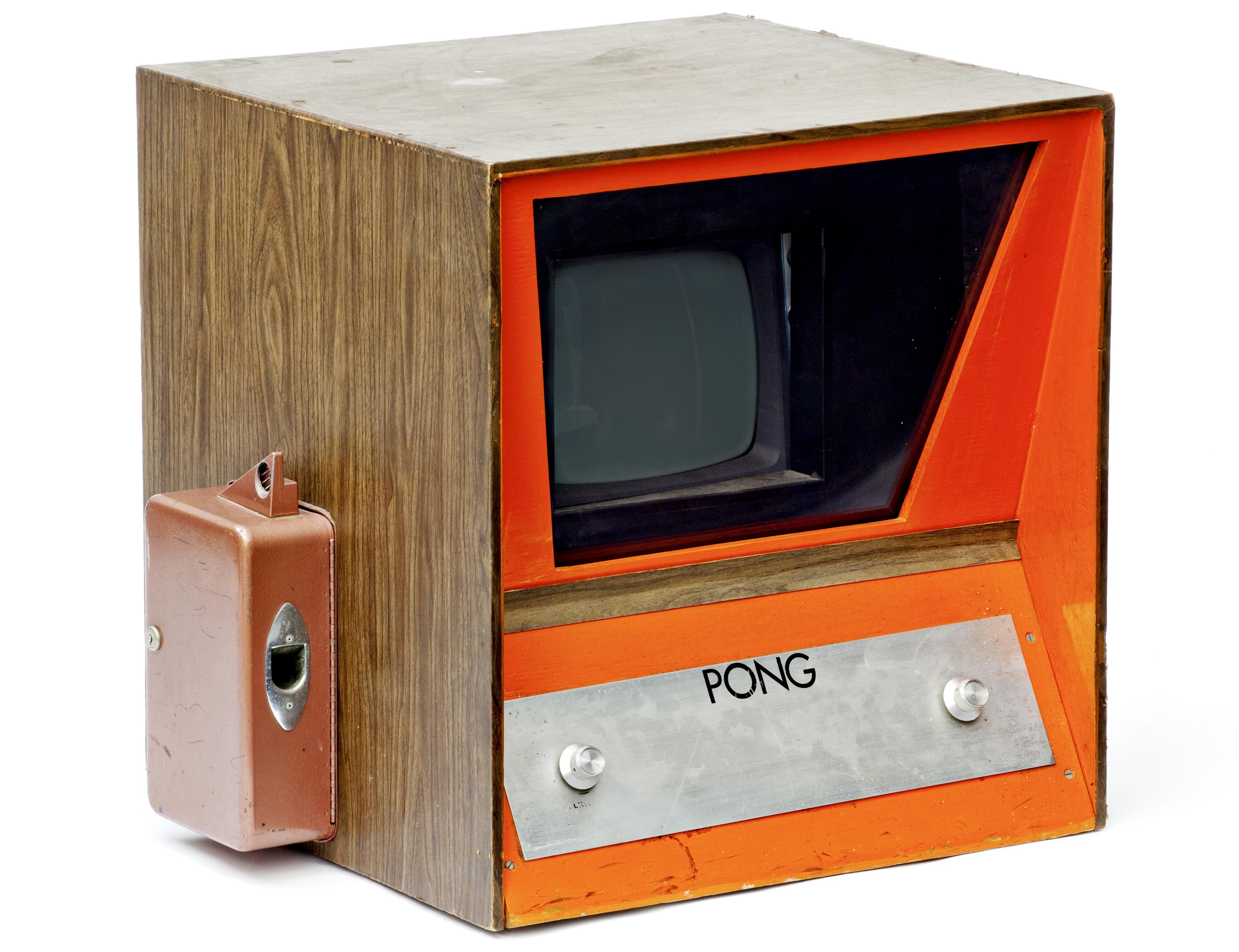
…And that’s how Pong- and Atari got it’s start… there were more sequels, bootlegs, and home consoles than just about any game in history. And started the industry we know today.
Arcade 1up also released a Pong machine in 2023.. to celebrate it’s 50th anniversary. because the game never had an actual rom… it was recreated faithfully. check it out the review from Jon at Gen X Grownup!
And a final thought from FranLab…
Keep Playin’ Like It’s 1981!
 The Arcade Archives!
The game that started it all. Simplistic, yet so addicting that having played it on my Atari 50 collection I can see the appeal Arcaders had when they first played it way back when. 🙂
Interestingly enough my exposure to Pong was through two things: a hidden feature in Mortal Kombat 2 (Arcade) and the off-shoot “Mortal Pongbat” for the original Macintosh computers during the 90s which helped add to Pong without taking away what made it special.
LikeLike