

Hey Arcaders!
1984 was a bad year in the arcades- a lot of companies lost their footing against the great crash that year- but saddest of all… was Universal. Having been around since December 1969, they really made their mark in the early 80s. But they were about to risk it all with not just a game… but something the industry was heading towards… an arcade SYSTEM. a machine that could be changed quickly. a new disk… a rom swap… and a new header.. you had a new game… ready to make money… in the same cabinet.. for a fraction of the cost of a new machine! But they took it further… it was going to be a FULLY ANIMATED LASERDISC GAME. it was the future… the savior of dwindling arcades…
… Sadly- it didnt.
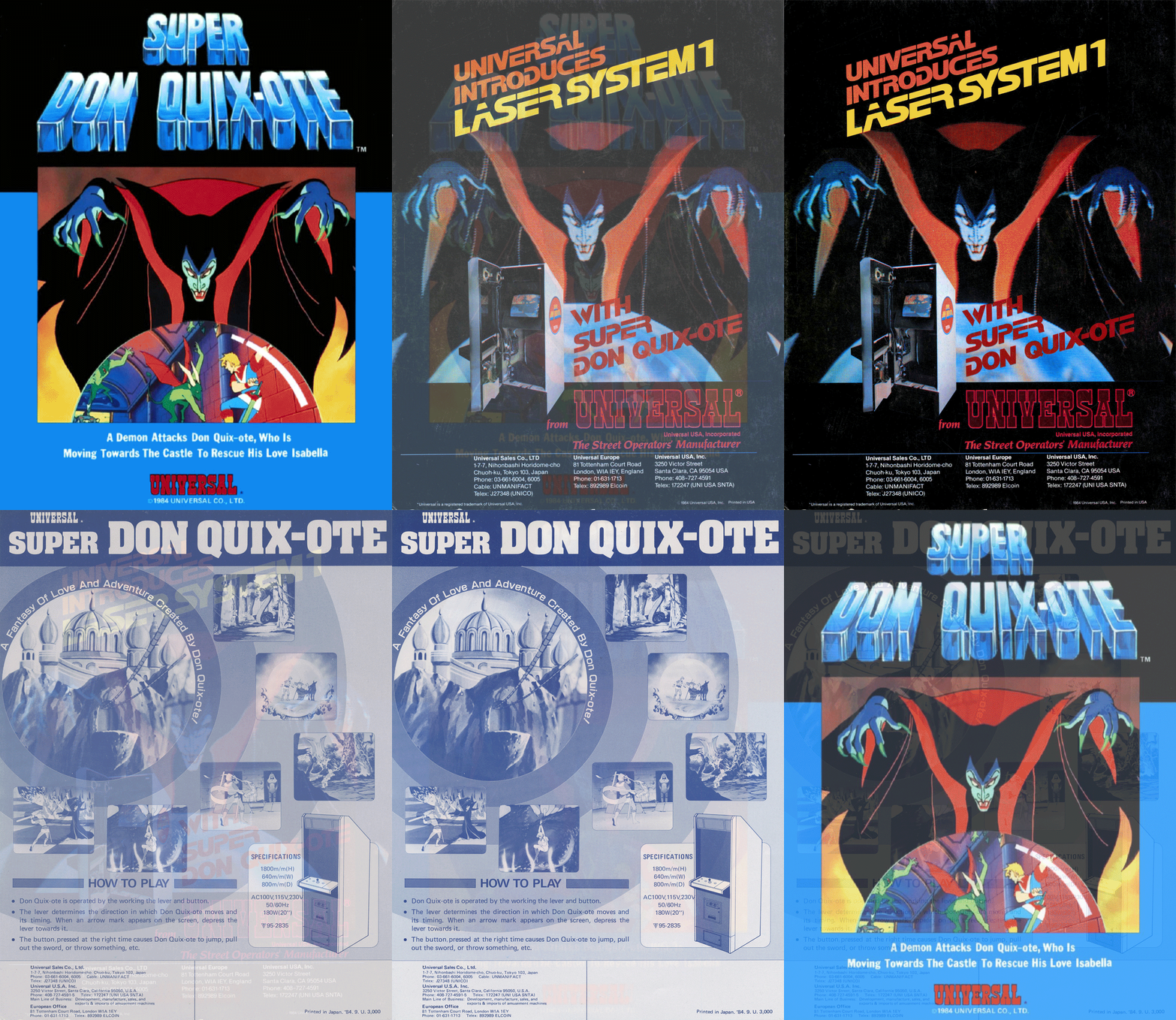
Super Don Quixote is a 1984 laserdisc‑based interactive film arcade game developed and released by Universal. It arrived during the height of the laserdisc craze, joining titles like Dragon’s Lair and Space Ace, but distinguished itself with a unique on‑screen input indicator system that made it more accessible and readable than its competitors.
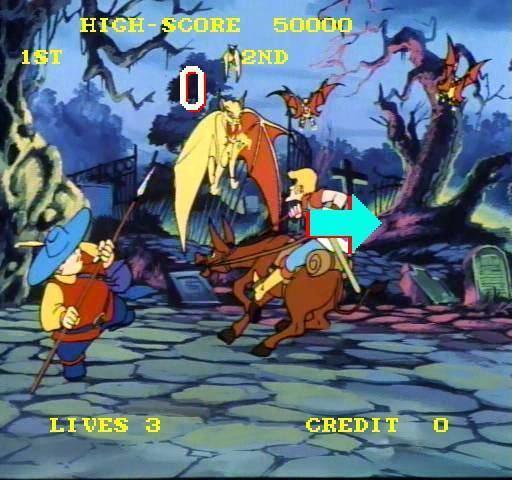
The game loosely adapts the themes of Don Quixote, placing players in the role of a heroic knight named Don on a quest to rescue Princess Isabella from the evil witch Leona.
According to contemporary release records, Super Don Quix‑ote rolled out across regions between late 1984 and early 1985: first Europe: October 1984 then Japan: November 1984 finally North America: February 1985
This positioned the game near the end of the laserdisc arcade boom, when operators were still experimenting with cinematic, animation‑driven experiences.
The game ran on Universal System 1, a platform designed to integrate laserdisc playback with traditional arcade controls.
This allowed:
- Full‑screen animated sequences
- Quick‑time‑event (QTE) style gameplay
- Smooth transitions between scenes.
Universal’s animation team produced vibrant, cartoon‑style sequences that gave the game a distinct personality compared to the more Western‑styled Don Bluth productions. The system corrected the one problem that laserdisc games had- lag. because the disk typically went through the scene- then indexed the deaths for that scene after- Universal took another approach- making the disk a series of quick time events- with the deaths AT THE MOMENT IT HAPPENED! It made for an almost seamless game- and surprisingly- put less stress on the player itself- since it didn’t have to roam the disk to find the appropriate death. Check out the disk footage! The animators had a good time with this game! You could tell they were fans of Dragon’s Lair!
Universal produced the game in relatively small numbers compared to its Mr. Do series. They created a dedicated cabinet (very rare) as well as releasing it to operators as a kit.
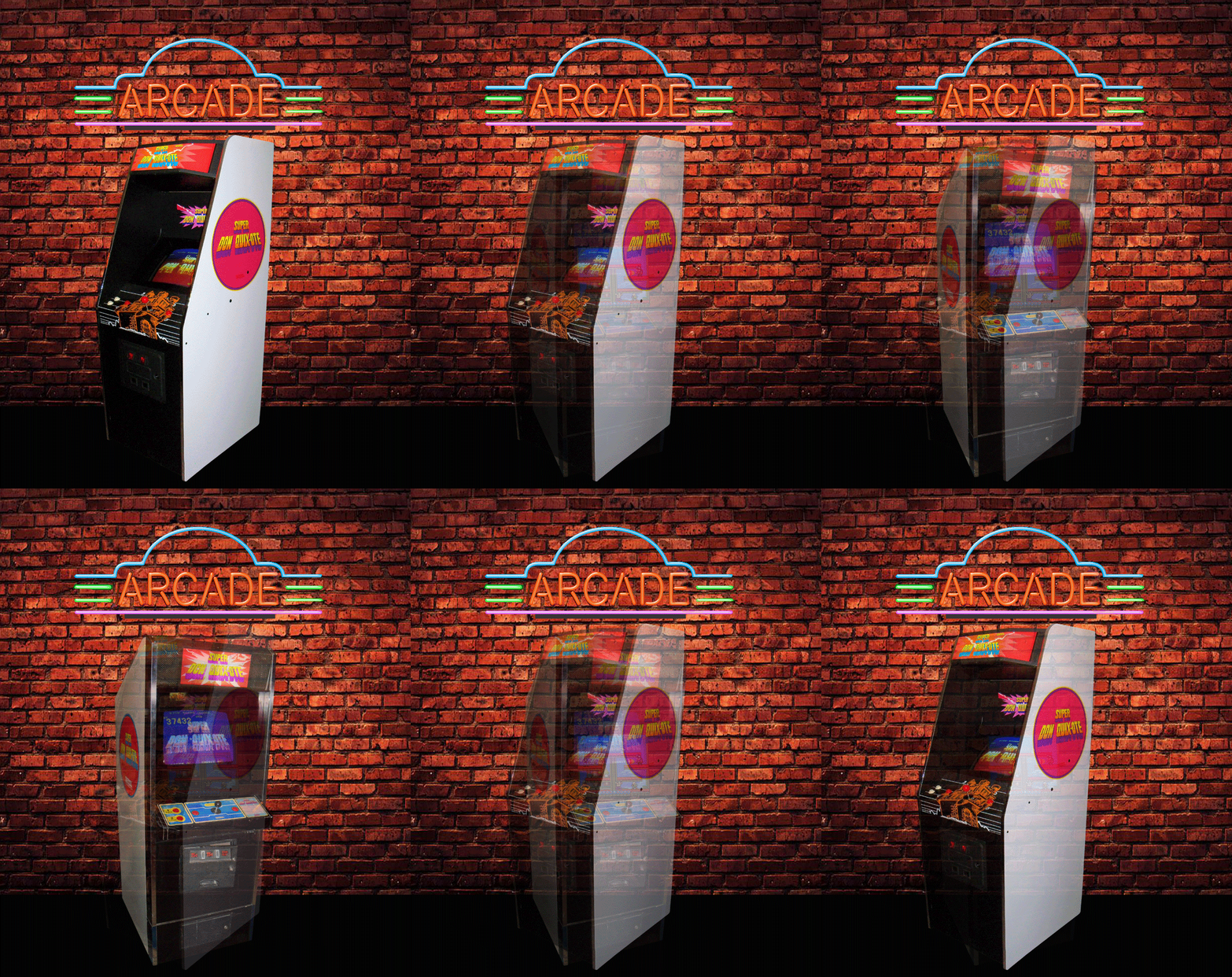
Collectors note that original laserdiscs, flyers, and cabinets are now rare and sought after. Unfortunately- what Universal did was soak all their assets into this project. The animation was the most expensive part. The cabinet- one of a kind- opening in the front to access everything- more money. Future releases and the cost of the system board- put it over the top. all during the North American Video Game Crash of ’84. A new game was planned every six months for the Universal System 1, including an unreleased laserdisc adventure game based on Mr. Do!, but the company stopped producing arcade games in 1985, and Super Don Quixote ended up being the only game released for the system. Universal Company LTD… closed it’s doors soon after the loss. Universal’s legacy still lives on today with collectors and enthusiasts. finding a Universal cabinet is a holy grail to many. The company survived a few years in different forms- Universal Distributing of Nevada (UDN) was established to begin selling Universal’s first slot machines direct to the gaming industry. A division, Universal Playland (UPL), was set up to continue the arcade game business. The company filed for bankruptcy on March 4, 1992.
Kazutoshi Ueda- the father of Mr. Do! later left Universal and went on to work at Tehkan (now Tecmo), then became a co-founder of Atlus, where he worked on the Megami Tensei series. Ueda’s work at Universal inspired the game design style of Tehkan’s Michitaka Tsuruta, who went on to create Guzzler (1983), Bomb Jack (1984), Solomon’s Key (1986), and the Captain Tsubasa game series.
I LOVED THIS GAME! in fact I was one of the first to own it in the country! You see… Universal’s assets were liquidated in an auction in California back in early 1986. a guy by the name of Pete owned a kit salles company called Video Connection. He had loose boards, whole kits and parts! you could even trade in you old boards (kind of an early GameStop or Electronics Boutique)! well he had ALOT of Universal’s parts and kits- including a kit for Super Don Quixote! you got the board all graphics and the disk for $199.00! I bought one as i had an extra Dragon’s lair cabinet with a working LDV1000- the laserdisc player used in a majority of laser games. a quick conversion later… and I had a SUPER DON QUIXOTE! I still play this game today through emulation! But what could have been… is a discussion for another time.
If you haven’t had a chance to play this remarkable game- it’s fully playable on the Daphne emulator!
Well- this is the end of our journey through this remarkable company- a company that had a bright beautiful run… that ended too quicky. What did you think of Universal? Did you have a favorite game? Let me know in the comments!
Keep Playin’ Like It’s 1981!
 The Arcade Archives!