


Hey Arcaders!
When we talk about the golden age of arcade gaming, names like Atari, Namco, and Taito usually dominate the conversation. But tucked among the giants was a creative and often underappreciated developer that carved out its own unique space: Universal Co., Ltd.

Universal didn’t just ride the arcade wave in the early ’80s—they helped shape it. With bright, quirky graphics, inventive gameplay mechanics, and a flair for experimentation, Universal delivered several memorable titles that still hold a place in the hearts of retro gamers.
So- for the next couple of months… We’re talking all things.. UNIVERSAL!
Origins & Early Years
- The company was founded December 1969 as Universal Lease Co., Ltd., originally for the purpose of leasing jukeboxes.
- In mid-1970 it began manufacturing amusement machines.
- In October 1971 the name was changed to Universal Co., Ltd.
Growth & Structural Changes
- In 1973 it spun off its sales division.
- In 1975 the company again changed its trade name to Universal Sales Co., Ltd.
- Around the same time it created or spun off other divisions for development and production.
Production & Expansion
- They built a factory in Oyama, Tochigi Prefecture for full‐scale production of various game machines.
- In 1980 they constructed a second factory (Oyama Factory No. 2) and expanded into pachislot machines (a Japanese style of slot machine) for the amusement & entertainment industry.
- In 1988, they added another manufacturing facility in Yonago, Tottori Prefecture, also for amusement machine production.
Arcade Game Business & Titles
- Universal Co., Ltd. released a number of arcade video games, especially during the late 1970s through early 1980s. Some of their known titles: Space Panic (1980), Lady Bug (1981), Mr. Do! (1982), Cosmic Avenger (1978), etc.
- Their arcade output had a phase of making clones of popular games (Breakout clones, Space Invaders clones) before moving into more original design.
- They attempted more ambitious systems like the Universal System 1, a laserdisc-based standard, but that didn’t have long lifespan; Super Don Quix-ote (1984) was the only game released for System 1 before Universal ceased arcade game production in 1985.
Later Years — Transition to Gambling / Pachinko & Corporate Changes
- After mid-1980s, Universal largely exited from making new arcade video games.
- In 1993, Universal “Hanbai” (their sales arm) bought out its parent (or merged with) and there were reorganizations.
- In 1998, Universal Technos Co., Ltd. absorbed Universal Sales Co., Ltd., and the company changed its name to Aruze Corporation. Headquarters were relocated to Ariake, Koto-ku, Tokyo.
- Later, in 2009, Aruze changed its name to Universal Entertainment Corporation.
Key Characteristics & Legacy
- Universal’s most successful arcade game (by recognition) is Mr. Do! (1982), which spawned several sequels.
- Other well-known games include Lady Bug, Space Panic, etc. These games are often remembered for their mechanics (e.g. Space Panic is considered a forerunner of platform/puzzle hybrids).After exiting arcade video games, the firm focused on pachinko, pachislot, gambling machines, etc., which remain a core business.
Let’s take the next couple of months and dig into the pixel-rich history of Universal’s arcade games during the 1980s.
Early Days: Platform Pioneers and Maze Masters
Space Panic (1980)

Before Mario climbed ladders or Donkey Kong started throwing barrels, Universal released Space Panic—a game that many consider the first true platformer.
- Players controlled a spaceman climbing ladders and digging holes to trap alien enemies.
- Though not a commercial smash, Space Panic was a critical forerunner, influencing Donkey Kong and other genre-defining titles.
Why it matters: It laid the groundwork for the platform genre and showcased Universal’s willingness to innovate.
Lady Bug (1981)

Lady Bug was Universal’s answer to Pac-Man, but it didn’t just imitate—it elevated.
- Players navigated a bug through a maze, collecting flowers and spelling bonus words, while avoiding predators.
- The rotating gates added a tactical twist, letting players dynamically change the maze layout.
Fun fact: Many retro fans argue Lady Bug is more strategic than Pac-Man—and more replayable, too.
Mr. Do! and the Breakout Mascot
Mr. Do! (1982)

Arguably Universal’s most iconic character, Mr. Do is a clown on a mission—digging tunnels, collecting cherries, and bonking enemies with a bouncing Powerball.
- Combined mechanics from Dig Dug, Pac-Man, and puzzle games.
- It’s one of the First arcade game to feature a continue option—a revolutionary concept at the time.
Mr. Do! was a hit both in Japan and North America, becoming one of the best-selling arcade cabinets of 1982.
The Mr. Do! Series
Universal capitalized on the success of its bouncy clown with a string of sequels that pushed genre boundaries:
- Mr. Do’s Castle (1983)

A platformer with ladders, unicorn enemies, and hammer-swinging action.
- Mr. Do’s Wild Ride (1984)

A frenetic game where Mr. Do dodges carts on a deadly roller coaster.
- Do! Run Run (1984)
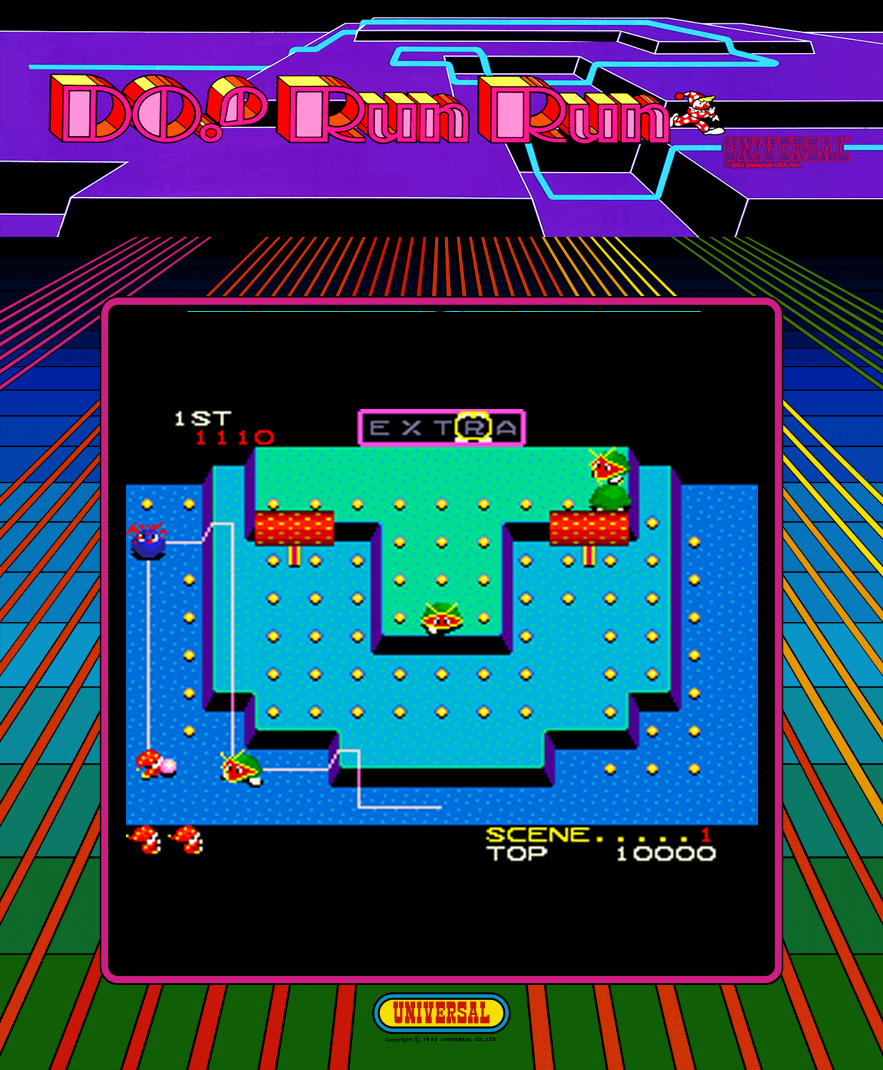
A lesser-known gem combining Qix-style line drawing with Mr. Do’s familiar antics.
Each sequel experimented with gameplay, showing Universal’s refusal to play it safe—even if it meant niche appeal.
Other Notable Titles from the ’80s
Universal’s catalog was deeper than just Mr. Do and bugs. Other standout releases include:
- Cosmic Avenger (1981) – A colorful, horizontally scrolling shoot-em-up. Often seen as a precursor to Defender.
- SnapJack (1981) – Guide a dot-munching, stretch-legged character through right-to-left scrolling scenes of landscape and tunnels. Avoid, among others, jelly fish and of course the kettles and boots on the overhead conveyor.
- Devil Zone (1980) – An early fixed shooter with a demonic twist.
- Zero Hour (1980) – A vertical shooter that built on the space invasion formula.
- Jumping Jack (1984) – A vertical climbing game that borrowed some cues from Donkey Kong.
- Super Don Quixote (1984) – Universal took the leap into Laserdisc games with this Dragon’s Lair spinoff- for a proposed laserdisc system. It improved on the technology, with different game formatting on the disk-As the death scenes were AFTER every movement- instead of the scene playing out- reducing wear and tear on the players laser head, as well as the score and movement cues being onscreen- superimposed over the animation!
While not all of these reached commercial success, they’re beloved by collectors and preservationists for their distinct style and early design ambition.
Decline and Fade into History
By the mid-to-late 1980s, Universal’s prominence in the arcade scene waned. As technology raced forward—bringing better graphics, sound, and new hardware—Universal struggled to keep pace with titans like Sega and Capcom.
Eventually, the company shifted away from arcade game development entirely. But their contributions to early arcade innovation remain undeniable.
Legacy: Still Clowning Around (In a Good Way)
Today, Universal’s arcade games live on in emulation communities, multi-game cabinets, and collector’s rooms around the world. Mr. Do! and Lady Bug frequently pop up in retro compilations and are often referenced by modern indie developers for their clever mechanics and colorful charm.
At The Arcade Archives.com, we celebrate companies like Universal not just for the games they made, but for how they inspired an entire generation of players and creators.
So next time you fire up your emulator or walk into a classic arcade, spare a moment for Universal—because without them, the golden age might have looked a lot different.
Did You Know?
- Lady Bug was originally rejected by Bally/Midway for being too similar to Pac-Man. Now it’s a cult favorite.
- Mr. Do! was Universal’s top-selling arcade game and was later ported to the SNES, Game Boy, and more.
- Universal was reportedly inspired by Hanna-Barbera cartoons—hence the colorful and whimsical style in their early games.
What’s your favorite Universal arcade game? Share your memories and high scores in the comments below or tag us on Facebook or on X-@ArcadeANetwork. Or just leave a moment in the comments below!
I can’t wait to get this one started!
Keep Playin’ Like It’s 1981!
 The Arcade Archives!